HAVANA, June 13 (Xinhua) -- Rumors have been hovering over the
streets of Havana in the last few days about a possible rollback in U.S.
policy towards the Caribbean island, reversing the historical detente
initiated in 2014 by former U.S. President Barack Obama.
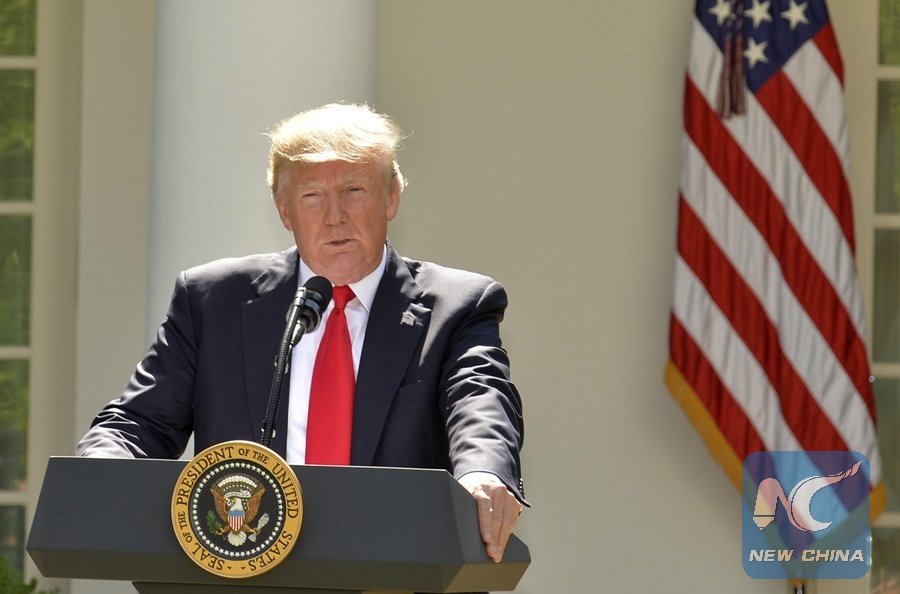
According to media reports, U.S. President Donald Trump is set to
announce in Miami on Friday a rollback to the thaw between Washington
and Havana, a promise he made during his election campaign last year.
For Cubans, this possible scenario would be a return to the past,
marked by political confrontation and economic limitations due to the
financial embargo that Washington has still imposed on the island.
"It would be a big mistake in President Trump's policy towards Cuba,
because the U.S. has many possibilities to invest and contribute to the
economic development of the country," said Javier Casamayor, a tourism
guide for the state-run Gaviota tour agency.
This firm, part of a business conglomerate belonging to the
Revolutionary Armed Forces, operates a five-star hotel in Havana along
with U.S. company Starwood.
According to different sources, the Trump administration has been
discussing policy changes that include prohibiting American firms from
doing business with companies associated to the Cuban military, such as
Gaviota.
"The tourism industry would be seriously harmed. Since relations were
restored, U.S. citizens have become the second largest group of
visitors to our country. If Trump limits them, there would be a direct
economic impact," said Casamayor.
The White House has also been debating new restrictions on U.S.
tourists to Cuba, which have more than tripled since Obama's 2014
announcement.
In the first five months of this year, about 284,500 U.S. citizens
visited Cuba under 12 U.S. government-permitted categories that include
people-to-people contacts, academic, cultural, and educational
exchanges.
The figure, disclosed on Tuesday by the Cuban ambassador to
Washington, Jose Ramon Cabanas, represents as many Americans who visited
the island in 2016.
"I am not sure that rolling back the policy will work because Cuba is
a very interesting destination for Americans. This is not about what
Donald Trump wants but rather what most Americans demand," Mac Josselin,
a U.S. tourist who was touring Havana, told Xinhua.
Like Josselin, thousands of Americans and U.S. organizations advocate
continuing the thawing bilateral ties as it contributes to the
development of both nations.
"I think Trump will change the policy and we will go back to the
past. It will be more difficult for Americans to come to Cuba and we may
see a return to confrontation, although I hope common sense prevails,"
Emilio de Leon, a Cuban-American, told Xinhua.
Other ideas under discussion, according to officials familiar with
the matter, include guidelines that would require Americans to formally
explain how their travel to Cuba benefits the United States and the
Cuban people, as well as increased scrutiny of travelers and the
frequency of their visits.
Travel restrictions could impact U.S. airlines with direct flights to Cuba as well as the cruise industry.
On Tuesday, U.S. Secretary of State Rex Tillerson said Cuba "must
begin to address human rights challenges" if it wants Washington to move
toward more normal relations.
Cuban President Raul Castro said earlier this year that his
government is willing to continue negotiating pending bilateral issues
with the new U.S. administration. However, he warned that Havana would
not make political concessions.
Before ending his term, Obama eliminated the controversial "wet
foot,dry foot" policy which granted special migratory treatment to
Cubans and allowed them to remain in the United States as permanent
residents.
Since the rapprochement began, authorities of the two sides have
signed more than 20 cooperation agreements in different areas and
several U.S. companies have successfully started operations in Cuba.
Airbnb, the world's largest online hotel service, said last week that
it has earned nearly 40 million U.S. dollars since entering the Cuban
market in early 2015.
"Obviously Trump is trying to please a hard line sector that is still
rooted in the past and does not want the best for the Cuban people,"
Nelson Lopez, a college student, told Xinhua.
In December 2014, in the most sweeping change in U.S.-Cuban relations
in five decades, Obama announced plans to normalize ties with Cuba in a
move that quickly sparked controversy at home.
Since then, improvements have been made in diplomatic, social and
commercial ties, while Cuba has experienced a tourism "boom" receiving a
record-high 4.1 million visitors in 2016.